|
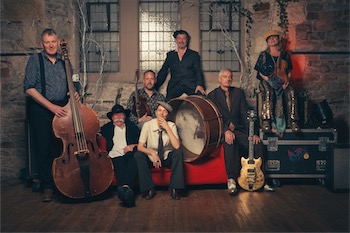
Over the past dozen or so years Shooglenifty's unique
twist on trad has won them an extensive and devoted fanbase
not only across Europe, the US and Australasia, but as
far afield as India, Malaysia and Japan.
Right now, the Edinburgh-based six-piece are just about
at the end of another whistlestop year of touring, taking
in France, Denmark, Belgium, Spain, Norway, Ireland, Italy
and Tenerife, as well as UK appearances. Previous career
highlights include performing for Prince Charles, Nelson
Mandela and Emperor Akihito of Japan (not all at once),
and playing in Cuba a full year before the Manic Street
Preachers' much-vaunted Louder than War gig in 2001. Back
in 1996, meanwhile, Shooglenifty became the first band
ever to incite a stage invasion at Sydney Opera House.
"We did invite them on stage, though," points
out the guitarist Malcolm Crosbie. "Angus [Grant],
our fiddle-player, could see that there wasn't enough
room for dancing - it's an all-seater venue, obviously
- so he just said to the audience, 'Plenty of room up
here...', and suddenly we were surrounded by a couple
of hundred people jumping around."
Among the current Shooglenifty line-up, the percussionist
James Mackintosh is the fourth remaining original member,
while the bassist Quee MacArthur and the Tasmanian expat
Luke Plumb, on mandolin, banjo and bouzouki, both joined
two years ago. The band's collective CV takes in backgrounds
as diverse as Crosbie's apprenticeship in alt.rock obscurity,
Finlayson's early blues fixation and Grant's childhood
immersion in the West Highland fiddle tradition. Beneath
their folky-looking exterior lurk electric as well as
acoustic guitar, samples and programming as well as "real"
percussion, while Finlayson switches between regular banjo
and his own customised hi-tech version, or "banjax".
All six players, though, are maestros of effects, distortion,
feedback and - crucially - improvisation.
The resulting sound marries traditionally based tunes
- primarily Scottish in style, but featuring a wealth
of other world-music flavours - with the rhythmic energy,
inventiveness and sophistication of contemporary dance
music. Such a description, though, hardly begins to capture
the dazzling multi-layered intricacy, exquisitely jewelled
lyricism and intoxicating, coruscating grooves that are
Shooglenifty's hallmarks. The band's own, none-too earnest
attempts at capsule descriptions include "hypno-folkedelic
ambient trance" and "acid croft".
The genesis of this hybrid musical strain can be traced
to around 1990, following the demise of celebrated Edinburgh
psychobilly outfit Swamptrash. Out of those ashes, five
of Shooglenifty's original members - including the mandolin
player Iain McLeod - began meeting up for weekly pub jam
sessions. The bassist Conrad Ivitsky joined, word of mouth
snowballed, and they were offered a weekly residency at
La Belle Angele, one of several much-loved venues in the
Scottish capital destroyed by last winter's Old Town fire.
>From these spontaneous, freewheeling beginnings,
Shooglenifty have since been hailed as one of the key
pioneers, and continuing frontrunners, in the field of
Celtic/clubland fusion. The Afro Celt Sound System might
be market leaders, but where they, by their own admission,
have only latterly evolved from a studio project into
an actual band, Shooglenifty have been the real deal all
along.
"We are the complete opposite of a manufactured
band - 100 per cent organic," agrees Crosbie. "That
first gig at La Belle, there were six people there apart
from us. It was the middle of winter, and we were all
huddled around this electric-bar fire in the middle of
the floor. By the time we actually migrated on to the
stage, a couple of months later, there were so many people
coming that we had to start using a PA. It really was
just a session that kept on evolving."
Despite this absence of calculation or contrivance, however,
there was no mistaking that something unusual was happening
with their audiences. "You just can't argue with
that many people having a good time - we were obviously
doing something right," says Finlayson. "I was
very conscious that a lot of people coming to see us had
only ever danced in clubs before, and it was definitely
that kind of groove-based approach we were after, yet
we never really discussed it in those terms: we just played.
It was two years before we had a rehearsal, and then only
because we were due to be making the first album."
This initial imposition of studio discipline proved to
be a vital catalyst. "It forced us to impose at least
an element of structure," Finlayson continues. "And
that led to the realisation that we could experiment and
improvise all we liked, get away with all kinds of nonsense,
as long as we built in a few islands of sanity amid the
chaos, to reassure the audience that we knew what we were
doing. Which is pretty much how we've carried on, really."
That 1994 debut, Venus in Tweeds, issued by the Scottish
folk independent Greentrax, remains the label's all-time
bestseller. It's been followed by three more albums (four,
if you count an early RealWorld live CD), most recently
The Arms Dealer's Daughter, released under the band's
own Shoogle Records imprint.
It follows a bumpy period in their career, with mounting
personal and interpersonal tensions eventually leading
to MacLeod's and Ivitsky's departure in 2001. After a
full decade with the same personnel, and given the calibre
and character of the players involved, finding suitable
replacements wasn't looking hopeful - but then in stepped
MacArthur, another longtime stalwart of Edinburgh's close-knit
roots scene, who'd already deputised on bass a few times.
Plumb, meanwhile, was serendipitously discovered busking
at the market in Hobart, while Ivitsky was on honeymoon
there.
The 22-year-old self-taught prodigy learned virtually
the band's entire repertoire from CDs and downloads in
record-breaking time, ready to join them when they flew
in for the Tasmanian leg of their tour. "We'd been
thinking he'd maybe do two or three numbers with us,"
remembers Crosbie, "but he came on right at the start,
and played the whole gig. Anything he wasn't quite sure
of, he just jammed - and it all sounded fantastic."
Besides his phenomenal playing on The Arms Dealer's Daughter,
Plumb also wrote more than half of its all-original material.
The new record's sparkling melodies, killer rhythms and
buoyant cosmopolitanism vividly reflect the mood of a
band enjoying a fresh lease of enthusiasm. "It's
nice to be learning again," says Crosbie. "When
you play with the same people for ages, you tend to know
the type of thing they're likely to do, and vice versa.
Having new people in the band makes it more exciting."
"Ten years without a single line-up change is a
very long time," Finlayson points out. "And
this is a band built on very strong personalities, intense
relationships and lots of creative friction. It's never
going to be all sweetness and light - although it is pretty
close right now."
|